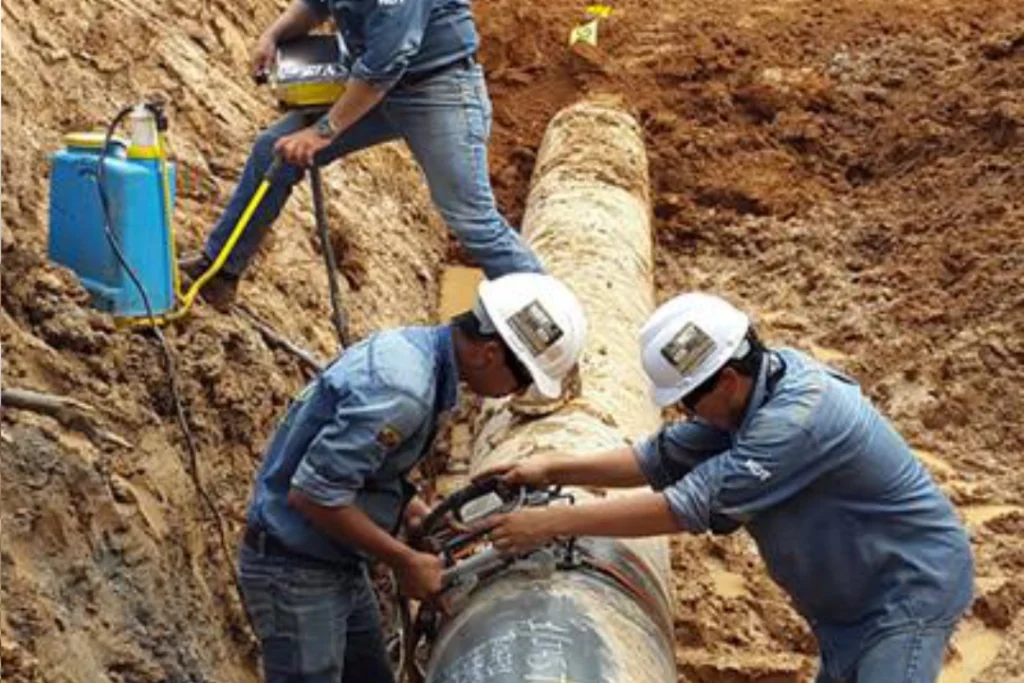
NNDT provides a range of specialised pipeline survey techniques designed to identify coating defects, locate pipelines and assess cathodic protection performance. These technologies provide clients with detailed field data that can be used to prioritise maintenance, investigate anomalies and support pipeline integrity management programmes.
DCVG — DIRECT CURRENT VOLTAGE GRADIENT
DCVG is used to locate and assess coating defects on buried pipelines by measuring voltage gradients in the soil surrounding the pipeline. The technique assists in identifying coating holidays and determining the relative severity of defects, enabling clients to prioritise excavation and coating repair activities.
ACVG — ALTERNATING CURRENT VOLTAGE GRADIENT
ACVG provides a non-intrusive method of locating and evaluating coating defects on buried pipelines using alternating current measurements. The technique can assist in identifying coating anomalies and prioritising locations for further investigation or repair.
PCM — PIPELINE CURRENT MAPPER
Pipeline Current Mapping (PCM) is used to trace buried pipelines and assess changes in current flow along the pipeline. Variations in current can assist in identifying coating defects, electrical anomalies and locations requiring further investigation. PCM provides valuable information for pipeline integrity and cathodic protection programmes.
GPS — GLOBAL POSITIONING SYSTEM SURVEYS
GPS surveying provides accurate geographical positioning of pipeline infrastructure, inspection findings, anomalies and associated assets. NNDT can integrate GPS data with field inspection results to improve asset mapping, traceability and the management of pipeline integrity information.
DEPTH OF COVER (DOC)
Depth of Cover (DOC) surveys determine the depth of buried pipelines and other underground infrastructure along the pipeline route. NNDT uses specialised surveying techniques to identify variations in pipeline burial depth and areas where the pipeline may have insufficient cover or increased exposure to external risks. This information assists clients in identifying vulnerable sections of pipeline, prioritising remedial work and maintaining compliance with required depth-of-cover specifications. DOC surveys can also be integrated with other pipeline integrity and specialised survey data to provide a more comprehensive understanding of pipeline conditions.
CIS — CLOSE INTERVAL SURVEY
Close Interval Survey (CIS) provides detailed information on the effectiveness of cathodic protection along buried pipelines by taking closely spaced pipe-to-soil potential measurements. CIS allows areas of inadequate or excessive cathodic protection to be identified and assists clients in assessing the performance of their CP systems and determining where corrective action may be required.
CONTINUOUS SOIL RESISTIVITY
Continuous soil resistivity surveying provides information on the electrical characteristics of the soil surrounding buried pipeline infrastructure. Soil resistivity is an important consideration in corrosion assessment and cathodic protection design. NNDT’s surveys assist clients in understanding changes in soil conditions along a pipeline route and using this information to support CP design, integrity assessments and corrosion management strategies.